And Finally: What’s a Monstrance and What’s Exposition
# Reflections
And Finally: What’s a Monstrance and What’s Exposition
This is an article written by Sister Lizzie Ruth of the Community of St Mary the Virgin, Wantage https://csmv.co.uk/.
It appeared in the Annual News from Wantage and Overseas 2024 – 25 and is quoted with her permission.
This past year we Sisters acquired a new monstrance. We use it weekly in chapel for Exposition. Over the past year it’s been a joy to me when some of our guests and some of our members of staff have asked questions such as: “What’s in that little cupboard on the chapel wall with the light beneath it?”. “What’s a monstrance?”, and “What’s Exposition?”
For the benefit of anyone reading this or visiting us who isn’t familiar with these things, let’s first give some answers to the above questions. The for the benefit of those of you who are familiar with these things, we’ll go a little deeper…
In the Old Testament we read about God miraculously leading the Israelites out of slavery and safely through the Red Sea. They then spend decades living in the wilderness learning to live more intimately with God. God feeds them daily with a miraculous bread-like substance called “manna”. God also dwells right in their midst. The Israelites are all camped around a central tent – the Tabernacle. God’s presence is in the Tabernacle in a very special way, particularly in the Holy of Holies where the Ark of the Covenant sits. The later Jerusalem Temples are modelled on the layout of this wilderness Tabernacle.
Fast forward some centuries and, in Jesus, God became flesh and dwelt among us. (The original Greek uses the phrase “tabernacled amongst us”. See the Old Testament echo?). Through the Incarnation God lived amongst us and “one with us” in yet a more profound way than before. Now, with it being God’s plan for Jesus to be crucified and buried and then to rise and ascend to heaven, Jesus “tabernacling amongst us” in his human body could only last thirty-three years or so.
But God had in store for us a way of being amongst us and “one with us” in yet a more profound way than even the Incarnation! Jesus spent quite a lot of time preparing his disciples for his death and for how he would be present with them in new ways once he had risen and ascended. He promised them the Holy Spirit, and that he and his Father would live within them. He also talked at length (John 6) about how his flesh and blood would be intrinsic to their future way of abiding in him – rather like vine branches receiving sap from the central vine, an image he uses elsewhere.
In the accounts of the Last Supper in the Gospels we read Jesus’ words about “this bread” becoming “my body broken for you” and “this cup” becoming “my blood shed for you”.
What exactly did he mean by this? Some Christian traditions feel it’s important to only use the Bible as our source for understanding Jesus and what the earliest Christians did and believed. Despite all that Jesus says in John 6, Christians in these traditions tend to believe that the bread and wine of Holy Communion is only meant to be symbolic of Jesus’ death for us and our close relationship with him. Other Christians feel that to understand the Bible well we also need to read the historic accounts of what the very earliest Christians believed and practiced. When we read these Christian documents from the first centuries, we see that from very early on indeed it was a widely held Christian belief that the bread and wine of Holy Communion were more than just symbolic; it was believe that Jesus was actually present in them in a very real way.
The belief that Jesus is present in the consecrated bread and wine of Holy Communion were more than just symbolic; it was believed that Jesus was actually present in them in a very real way.
The belief that Jesus is present in the consecrated bread and wine in such a special physical way is called “Real Presence”. Used in this way, “real” doesn’t mean the opposite of “unreal”. It means something more like “thingly” or “material”. This belief gave rise to a great veneration for and care of the consecrated bread and wine of Holy Communion, including a later practice of keeping some of the bread safe in a little locked cupboard or chest (tabernacle) in a church building. This meant it could be taken quickly to someone who was sick or dying. Also, by keeping some of the consecrated bread in each church building, Jesus could be present there in a special physical way.
Within our tradition [that, also of St Peter’s] many churches, and convent and monastery chapels have a tabernacle in them in which Jesus dwells in this special physical way [cf Old Testament Tabernacle and Ark of the Covenant]. It is the Real Presence of Jesus in the tabernacle that we Sisters bow to whenever we enter our chapel.
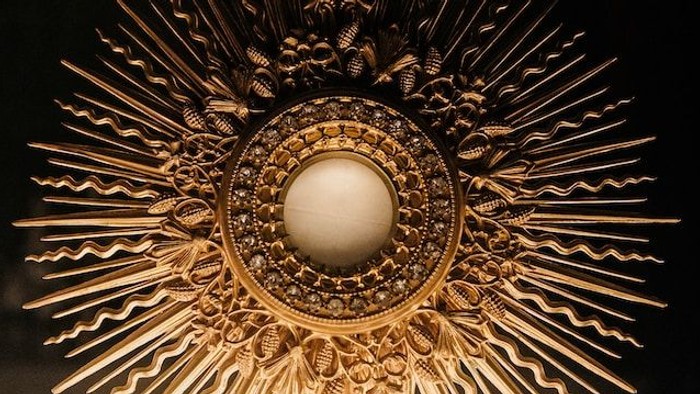
Now, the consecrated bread in the tabernacle is hidden from view. This is where a monstrance comes in. The word “monstrance” is linked to the word “demonstrate”. A monstrance is a free-standing frame for displaying the consecrated bread of Holy Communion. Exposition is a contemplative service in which we set the consecrated bread in the monstrance on the altar so that we can look at it, meditate on Jesus’ present with us in such a special way, meditate on Holy Communion, and pray in Jesus physical presence. Some guests who’ve experienced Exposition for the first time whist staying with us have said how profound they found it.
This leads me to some caveats. The bread and wine of Holy Communion are predominantly for consuming. Meditating on them in Exposition is good in that it helps us partake of Holy Communion even more mindfully and reverently.
It’s not as if Jesus is only in the Blessed Sacrament. Take focus on the Real Presence too far and we’d spend too much time in chapels or in Exposition to neglect the other aspects of life where Jesus is arguably equally present.
If we can learn to see Jesus in what looks like ordinary bread, we can learn to see Jesus in other people and events and the world around us.
Also, as Christians who consume Jesus’ own Body and Blood and in whom God dwells, it follows that we ourselves are tabernacles and monstrances. To meditate on how each of us is a tabernacle, read the writings of St Elizabeth of the Trinity. To meditate on how each of us is a monstrance, read the sayings of Mother Teresa of Calcutta.
I’ll end with the earliest Christian statement we have about Holy Communion. It’s from one of the letters of St Paul who wrote his letters before the gospels were written.
“The cup of blessing that we bless, is it not a sharing in the blood of Christ? The bread that we break, is it not a sharing in the body of Christ?” (1Cor 10: 16,17)
Central to Christianity and to Holy Communion is the fact that God invites us to an astonishingly mutual and intertwined life. This is actually something way beyond “simply” worshipping God, acknowledging God’s presence, being fed by God, meditating on Christ’s passion, accepting our salvation. Think of the difference between a parent feeding a child or giving a child medicine, and the relationship that a married couple has. Of course, God does feed us and heal us through Holy Communion but I believe this Sacrament is about something even more deeply mutual. It’s this profound participation in Christ’s life and death and resurrection and participation in the very Life of the Trinity (like we see in the Christian mystics) that I believe is the deepest meaning of Holy Communion.
So let’s not “just” prayerfully acknowledge Christ in the Blessed Sacrament or reverently consume Christ’s Body and Blood. But, with Jesus running through our veins and the Holy Spirit within us, let’s be full participators in the astonishingly mutual and intertwined relationship to which God’s inviting us…